Where abdominal CT AI is still underserved
Imaging AI has matured fastest in stroke and chest, where the clinical payoff is sharp. The abdomen, with its many organs and contrast-dependent findings, has been left comparatively thin.
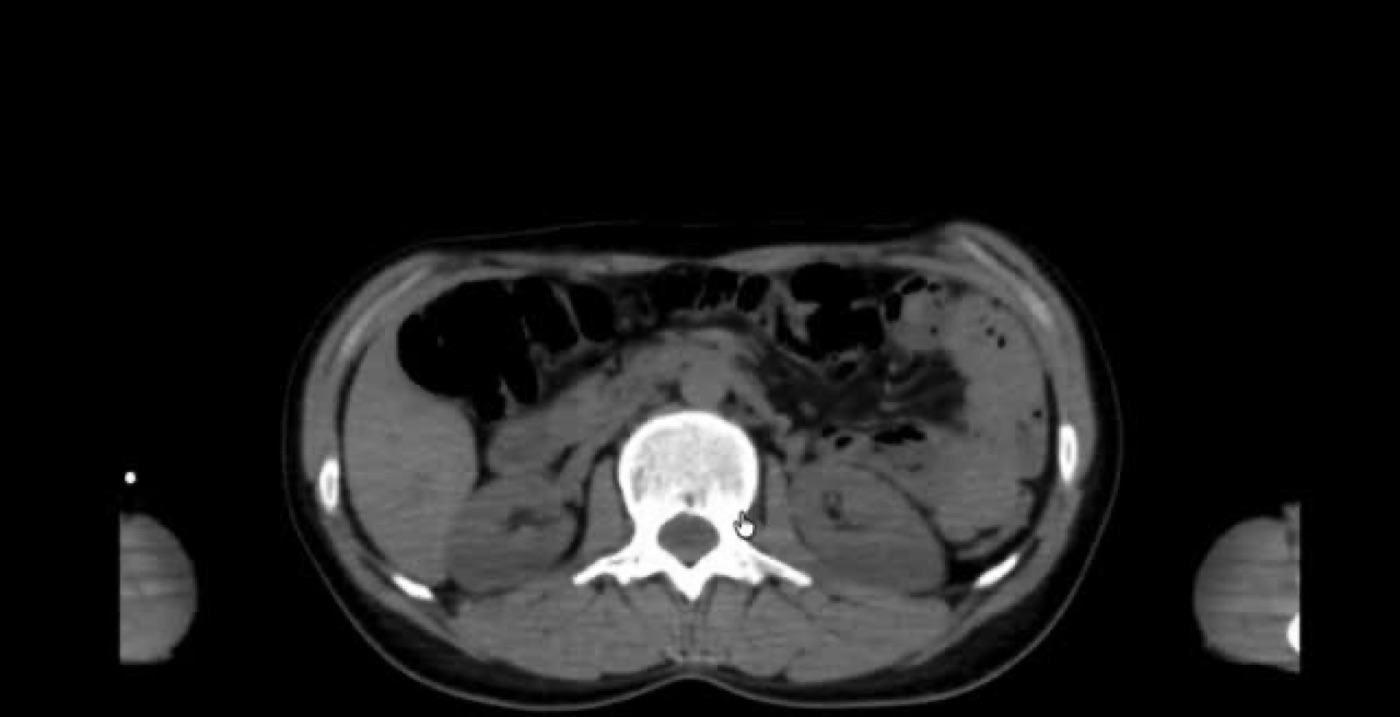
Follow the clearances
If you want to see where medical-imaging AI has matured, look at where the FDA clearances concentrate [1][2]. Stroke and chest dominate, because the clinical payoff is sharp and measurable: door-to-needle and door-to-device times in stroke, rapid pulmonary-embolism flags in the chest. The abdomen, by contrast, is comparatively thin on multi-pathology emergency tools.
Why the abdomen is harder
The abdomen is not neglected by accident. It packs many organs into one volume, acute findings range from a calcified stone of a few pixels to diffuse pancreatic inflammation spanning regions, and conspicuity swings with contrast phase. A single-finding flag does not capture a busy abdominal study the way it captures a single large-vessel occlusion.
Classification is not the finish line
A recent scoping review found that explicit detection with localization remains uncommon in abdominal radiology AI [3], even as broad classifiers covering many conditions have appeared [4]. Knowing that a study is abnormal is useful; knowing which finding, where, and being able to draft it into a report is what a busy emergency read actually needs.
The wedge we chose
Atlas is a deliberate bet on that gap: six abdominal emergencies, localized and region-mapped, on hardware a hospital controls. It is research-stage, and the honest framing is that the opportunity is defined as much by what is missing from the cleared landscape as by any single result.
References
- U.S. Food and Drug Administration. Artificial Intelligence-Enabled Medical Devices (authorized device list).
- American College of Radiology Data Science Institute. AI Central: directory of FDA-cleared radiology AI.
- Fotis A, et al. From promise to practice: a scoping review of AI in abdominal radiology. Abdom Radiol. 2026;51:1608-1617.
- Rajpurkar P, et al. a2z-1 for multi-disease detection in abdomen-pelvis CT. arXiv:2412.12629. 2024.